
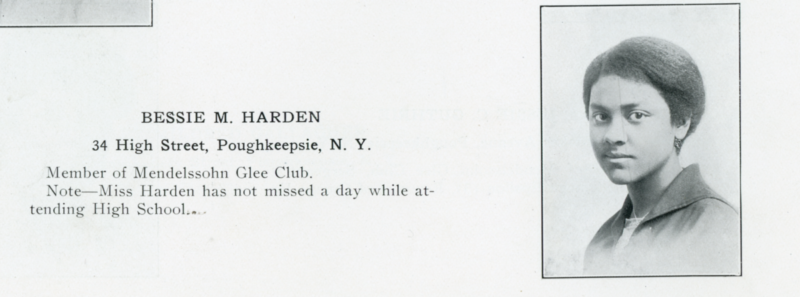
In 1984, Bessie Harden Payne had a humanitarian award named after her. She received a New York State Legislature Award in 1974 for her tireless work to improve the quality of life for senior citizens.
She was a two-term president of the Empire State Education for Women’s Clubs, an organization championing education for African American women. The organizations philanthropic endeavors were also an integral part in providing assistance to Harriet Tubman in the final years of her life, and making her home a national historic site.
Bessie was a principal for the Little Red Schoolhouse, a school for children with special needs. This school was the precursor to Abilities First, an organization that provides education for people with disabilities to support their independence, and to lead productive, fulfilling lives.
She received the Distinguished Achievement Woman of the Year Award in 1964 from the Poughkeepsie Professional Women’s Business Clubs. She was the Chairman of the Dutchess County Red Cross during in the 1970’s.
During the 1930s and 1940s, she played a role in the desegregation of stores and institutions within Poughkeepsie, so that people of color could either work (Luckey, Platt & Co.) or patronize (The Nelson House) these establishments.
A list of her achievements would scroll down an endless amount of pages. But her life, and how she led it, should be revered not as just words on a page.
“When you ask friends and co-workers of Bessie H. Payne to give one example of what she meant to the City of Poughkeepsie, they can’t, because she did so much,” wrote Christopher Landry, staff writer at the Poughkeepsie Journal in 1991.
“She did so many things for so long that it’s unfair to pick anything in particular,” added former Poughkeepsie County Legislator Marshall Roberts. “She was the forerunner for every program that helped blacks and others in the city.”
This is just the tip of the iceberg when it comes to how much of a community giant Bessie Harden Payne was to the City of Poughkeepsie.
Bessie was born here in 1895, to John and Mary Woods Harden. Her grandfather, James Harden, was a Civil War veteran who worked as a waiter on Hudson River Steamboats, an early steamboat company. Her mother, Mary Woods, came from Stonington, Connecticut, and would become a strong voice in Poughkeepsie’s African American community as well.
Bessie graduated from Poughkeepsie High School in 1914, becoming one of the very few Black students to graduate from the public school system. While still in school, Mrs. Mary Harden and Bessie started the Poughkeepsie Neighborhood Club. They were a group of 12 women at this time. The purpose of the group was to help other women become engaged in civil work, and to support local women in general.
After graduating from high school, Bessie enrolled in the Lynchburg Virginia Seminary & College. She graduated from this institution, and also found her future husband, the Reverend Herbert Payne. Reverend Payne was a member of the Metropolitan Church in New York City.

Fundraiser for Bessie Payne’s Missionary Work; 1916
The next chapter in their lives would forge a path to helping people for years to come. In 1917, the couple sailed to South Africa to become Baptist missionaries. They dedicated themselves to this work for the next six years, returning home in 1923. They would both speak of their experiences at Baptist conventions throughout the country.

Bessie Harden Payne’s Passport Extension 1923 (while in South Africa)
The Payne’s would live in Jamaica, New York, and then near Albany through the 1920s and 1930s. Rev. Payne had congregations in both places. During the Great Depression, Rev. Payne worked as a director in the Works Progress Administration (WPA). Bessie worked in the Baptist Home Mission Society. She also became friends with Dr. Mary McLeod-Bethune, the founder of Bethune-Cookman College in Florida. At that time, McLeod-Bethune was a high ranking member in the FDR presidential administration.

Bessie Harden Payne & Rev. Herbert Payne
During this period, prominent members of Poughkeepsie’s African American community, which included Mrs. Harden, Attorney Gaius Bolin (his daughter Jane became the first female African-American judge in the US), Dr. Robert Wesley Morgan, Bessie Payne, and others, pressured and persuaded for the hiring of black people within Poughkeepsie’s most revered companies, and hospitals (St. Francis, Vassar, and Hudson River State).
Bessie Payne’s father worked at the Nelson House for decades. The famous opera singer, Marian Anderson, who played at both the Bardavon and Poughkeepsie High School, had to take a train back to New York City after her performances because she was unable to stay at the segregated Nelson House and other local hotels.
The work and determination from this community’s activism was the spearhead to change these rules. This group, along with others throughout the country, was the bedrock for the burgeoning Civil Rights Movement that was so successful during the twentieth century.
In 1942, the Poughkeepsie Neighborhood Club celebrated its thirtieth anniversary. The Catharine Street Community Center was established in 1922, and then incorporated in April of 1942. The Poughkeepsie Neighborhood Club was attributed for the creation of this outstanding organization. Both of these societal pillars still exist and thrive today. Bessie Payne and her mother, Mary Harden, were there from the beginning.
On August 17, 1952, Rev. Herbert Payne died of a heart attack in their home in Chatham, New York, at the age of 60. Bessie moved back to Poughkeepsie and began teaching at the Little Red Schoolhouse. She soon became the school’s principal. In 1954, her son Herbert died suddenly after a brief illness in New York City. He was only 32. After her son’s death, Bessie rededicated herself to her faith at the Ebenezer Baptist Church, and gave even more of her time and effort to community work.
And from this point on, we circle back to where we started. Bessie Harden Payne immersing herself into causes that would benefit the citizens of this city for decades to come.
Bessie passed away in 1991 at the age of 96.

(A special thank you to patron Carol Thompson, who brought Bessie Harden Payne to my attention while she was doing research in our History Room)
References
- Landry, Christopher. “Payne Legacy: She Served.” Com, Poughkeepsie Journal , 3 Aug. 1991, www.newspapers.com/image/114381668/.
- “The Sunday School of Ebenezer Baptist Church.” Com, The Poughkeepsie Eagle, 20 Dec. 1916, www.newspapers.com/image/114124127/.
- Mamiya, Lawrence. “Mrs. Bessie Harden Payne.” Org, Dutchess County Historical Society Yearbook Volume 82 1999-2000, 2000, dchsny.org/
- Roberts, Lorraine M. “Enchanting Oral History Unfolded.” Com, Poughkeepsie Journal , 22 Feb. 1980, www.newspapers.com/image/114828531/.
- “Bessie Harden Payne in the U.S., Passport Applications, 1795-1925.” Com, www.ancestry.com/search/collections/1174/records/2211393?tid=&pid=&queryId=2410c029-00d6-4ba4-b162-f2a29a7e2716&_phsrc=bIx1671&. Accessed 18 Feb. 2026.
- Mamiya, Lawrence H., and Lorraine M. Roberts. “Invisible People, Untold Stories: A Historical Overview of the Black Community in Poughkeepsie.” Org, from Dutchess County Historical Society Yearbook Vol 072 1987by D C H S | NY, 28 Mar. 2022, issuu.com/dchsny/docs/dchs_yb_v072_1987_masterfile/s/15271839.